Trudenty Trust Center
Blog
Building Trusted AI for Financial Services: Trudenty Announces ISO 27001 and SOC 2 Compliance
Building Trusted AI for Financial Services: Trudenty Announces ISO 27001 and SOC 2 Compliance
Building Trusted AI for Financial Services: Trudenty Announces ISO 27001 and SOC 2 Compliance
Trudenty is now ISO 27001 certified and SOC 2 Type I compliant, reinforcing privacy-preserving, explainable, and audit-ready AI for high-stakes payments and fraud.

Lerato Matsio
Over the past year, AI has become deeply embedded in how financial institutions assess risk, prevent fraud, and manage trust. But as models increasingly influence high-stakes outcomes — from payment authorisation to dispute assessment — the question is no longer whether AI can solve these problems.
It’s whether the AI we rely on is safe, transparent, and governed responsibly.
At Trudenty, we build technology that sits at the intersection of payments, risk, and consumer trust. Our Trust Index models power sensitive decision-support across networks and financial institutions, and because of this, responsible AI governance is not a feature of our platform — it is a foundational principle of how we operate.
Today, we’re proud to share that Trudenty is now ISO 27001 certified and SOC 2 Type II compliant.
These certifications reflect our commitment to building secure, privacy-preserving, and audit-ready AI for some of the most regulated environments in the world.
Why AI Governance Matters
Fraud and risk decisioning systems cannot be black boxes. They need to be explainable so that risk, product, and governance teams can understand why a decision or score was produced. They must be fair in how they treat different customers and behaviours, and continuously monitored to detect drift, instability, or unintended outcomes. They have to be privacy-preserving by design, properly governed throughout their lifecycle, and auditable so that every decision-support signal can be traced and reviewed. Above all, they must operate in a way that is fully aligned with client oversight and control, rather than replacing it.
This becomes even more important as the industry shifts toward increasing rates of first-party fraud, real-time and A2A payments that offer no post-transaction dispute buffer, and emerging autonomous or agentic payment flows that transact on behalf of customers. At the same time, regulatory expectations around AI are rising, and financial institutions are under growing pressure to build cross-ecosystem trust intelligence rather than relying on siloed signals.
In this environment, strong AI governance is not optional — it is part of the core infrastructure required to run a modern financial institution.
Trudenty’s Approach to Responsible AI
Over the past months, we have invested heavily in building a governance model that meets — and often exceeds — the expectations of global financial institutions. Our AI systems are designed with:
Privacy by Design
All model execution happens inside the client’s secure environment. We never access PII, raw transaction data, or production systems.
Explainability & Transparency
Models produce reason codes, signals, and contribution insights — giving governance teams full visibility into how each score is formed.
Human Oversight
The Trust Index is a decision-support signal, not a decision-maker. Clients maintain complete operational and decisioning control.
Monitoring & Drift Detection
We provide metrics for fairness, stability, distribution shifts, and data-quality integrity — allowing institutions to meet internal model-risk standards.
Lifecycle Governance
Every model version is fully documented, validated, reviewed, and approved by clients before deployment.
Strong governance enables us to support mission-critical payment workflows confidently and responsibly.
Why We Invested in ISO 27001 and SOC 2
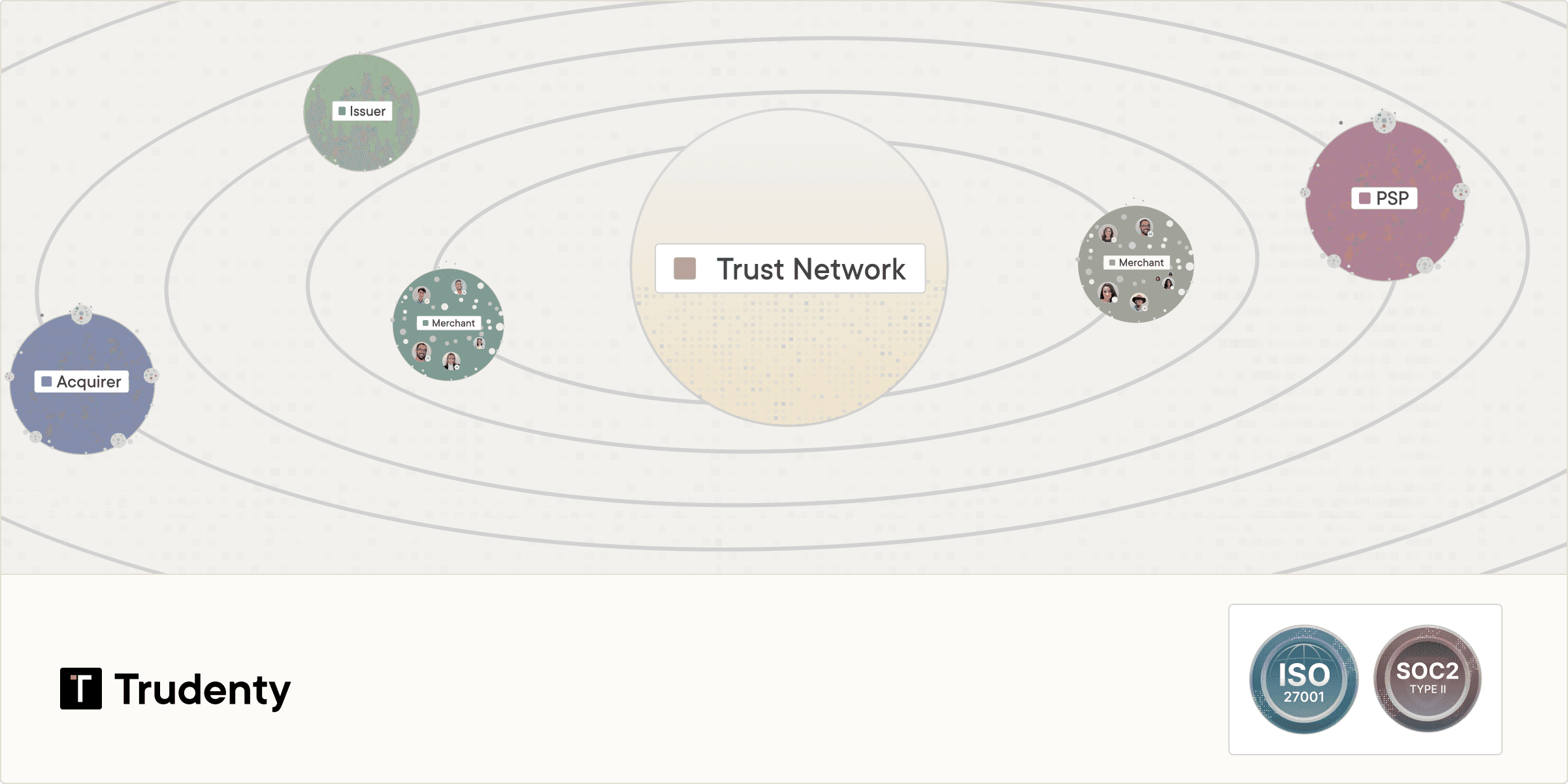
Trudenty’s Trust Network directly influences dispute outcomes, fraud losses, payment approvals, and ultimately the integrity of financial systems. Because our technology sits at the heart of these high-stakes decisions, we have always believed that enterprise-grade governance and security controls must be built in from day one — long before they become a contractual requirement or a scaling bottleneck.
This is why we chose to invest early in formal certification. Our ISO 27001 and SOC 2 Type I achievements reflect our commitment to security, data integrity, and operational excellence as we expand into new markets and support increasingly complex payment environments. These foundations ensure that our partners can rely not only on our performance, but on our safety, transparency, and trustworthiness.
Introducing the Trudenty Trust Center
To support enterprise and governance teams, we’ve launched the Trudenty Trust Center — a home for our:
Security certifications
Responsible AI Statement
AI Governance Overview
Architecture documentation
Privacy practices
Compliance commitments
Risk, compliance, and procurement teams can request supporting documentation directly through the Trust Center.
👉 https://trudenty.com/trust-center
In a market where ‘trust’ is often used as a marketing claim rather than a true design principle, we’ve chosen to make ours fully inspectable. The Trust Center gives risk, compliance, and procurement teams direct access to the evidence behind our commitments.
Looking Ahead
As agentic payments, real-time rails, and ecosystem-level fraud risks grow, the ecosystem does not need another fraud tool, it’s trust infrastructure so that trust can finally travel as freely as money.
Our mission is to build that foundation — responsibly, securely, and transparently.
With strong governance, explainability, and security at the core of our platform, Trudenty is committed to shaping a safer and more trustworthy future for global payments.
Over the past year, AI has become deeply embedded in how financial institutions assess risk, prevent fraud, and manage trust. But as models increasingly influence high-stakes outcomes — from payment authorisation to dispute assessment — the question is no longer whether AI can solve these problems.
It’s whether the AI we rely on is safe, transparent, and governed responsibly.
At Trudenty, we build technology that sits at the intersection of payments, risk, and consumer trust. Our Trust Index models power sensitive decision-support across networks and financial institutions, and because of this, responsible AI governance is not a feature of our platform — it is a foundational principle of how we operate.
Today, we’re proud to share that Trudenty is now ISO 27001 certified and SOC 2 Type II compliant.
These certifications reflect our commitment to building secure, privacy-preserving, and audit-ready AI for some of the most regulated environments in the world.
Why AI Governance Matters
Fraud and risk decisioning systems cannot be black boxes. They need to be explainable so that risk, product, and governance teams can understand why a decision or score was produced. They must be fair in how they treat different customers and behaviours, and continuously monitored to detect drift, instability, or unintended outcomes. They have to be privacy-preserving by design, properly governed throughout their lifecycle, and auditable so that every decision-support signal can be traced and reviewed. Above all, they must operate in a way that is fully aligned with client oversight and control, rather than replacing it.
This becomes even more important as the industry shifts toward increasing rates of first-party fraud, real-time and A2A payments that offer no post-transaction dispute buffer, and emerging autonomous or agentic payment flows that transact on behalf of customers. At the same time, regulatory expectations around AI are rising, and financial institutions are under growing pressure to build cross-ecosystem trust intelligence rather than relying on siloed signals.
In this environment, strong AI governance is not optional — it is part of the core infrastructure required to run a modern financial institution.
Trudenty’s Approach to Responsible AI
Over the past months, we have invested heavily in building a governance model that meets — and often exceeds — the expectations of global financial institutions. Our AI systems are designed with:
Privacy by Design
All model execution happens inside the client’s secure environment. We never access PII, raw transaction data, or production systems.
Explainability & Transparency
Models produce reason codes, signals, and contribution insights — giving governance teams full visibility into how each score is formed.
Human Oversight
The Trust Index is a decision-support signal, not a decision-maker. Clients maintain complete operational and decisioning control.
Monitoring & Drift Detection
We provide metrics for fairness, stability, distribution shifts, and data-quality integrity — allowing institutions to meet internal model-risk standards.
Lifecycle Governance
Every model version is fully documented, validated, reviewed, and approved by clients before deployment.
Strong governance enables us to support mission-critical payment workflows confidently and responsibly.
Why We Invested in ISO 27001 and SOC 2
Trudenty’s Trust Network directly influences dispute outcomes, fraud losses, payment approvals, and ultimately the integrity of financial systems. Because our technology sits at the heart of these high-stakes decisions, we have always believed that enterprise-grade governance and security controls must be built in from day one — long before they become a contractual requirement or a scaling bottleneck.
This is why we chose to invest early in formal certification. Our ISO 27001 and SOC 2 Type I achievements reflect our commitment to security, data integrity, and operational excellence as we expand into new markets and support increasingly complex payment environments. These foundations ensure that our partners can rely not only on our performance, but on our safety, transparency, and trustworthiness.
Introducing the Trudenty Trust Center
To support enterprise and governance teams, we’ve launched the Trudenty Trust Center — a home for our:
Security certifications
Responsible AI Statement
AI Governance Overview
Architecture documentation
Privacy practices
Compliance commitments
Risk, compliance, and procurement teams can request supporting documentation directly through the Trust Center.
👉 https://trudenty.com/trust-center
In a market where ‘trust’ is often used as a marketing claim rather than a true design principle, we’ve chosen to make ours fully inspectable. The Trust Center gives risk, compliance, and procurement teams direct access to the evidence behind our commitments.
Looking Ahead
As agentic payments, real-time rails, and ecosystem-level fraud risks grow, the ecosystem does not need another fraud tool, it’s trust infrastructure so that trust can finally travel as freely as money.
Our mission is to build that foundation — responsibly, securely, and transparently.
With strong governance, explainability, and security at the core of our platform, Trudenty is committed to shaping a safer and more trustworthy future for global payments.
Over the past year, AI has become deeply embedded in how financial institutions assess risk, prevent fraud, and manage trust. But as models increasingly influence high-stakes outcomes — from payment authorisation to dispute assessment — the question is no longer whether AI can solve these problems.
It’s whether the AI we rely on is safe, transparent, and governed responsibly.
At Trudenty, we build technology that sits at the intersection of payments, risk, and consumer trust. Our Trust Index models power sensitive decision-support across networks and financial institutions, and because of this, responsible AI governance is not a feature of our platform — it is a foundational principle of how we operate.
Today, we’re proud to share that Trudenty is now ISO 27001 certified and SOC 2 Type II compliant.
These certifications reflect our commitment to building secure, privacy-preserving, and audit-ready AI for some of the most regulated environments in the world.
Why AI Governance Matters
Fraud and risk decisioning systems cannot be black boxes. They need to be explainable so that risk, product, and governance teams can understand why a decision or score was produced. They must be fair in how they treat different customers and behaviours, and continuously monitored to detect drift, instability, or unintended outcomes. They have to be privacy-preserving by design, properly governed throughout their lifecycle, and auditable so that every decision-support signal can be traced and reviewed. Above all, they must operate in a way that is fully aligned with client oversight and control, rather than replacing it.
This becomes even more important as the industry shifts toward increasing rates of first-party fraud, real-time and A2A payments that offer no post-transaction dispute buffer, and emerging autonomous or agentic payment flows that transact on behalf of customers. At the same time, regulatory expectations around AI are rising, and financial institutions are under growing pressure to build cross-ecosystem trust intelligence rather than relying on siloed signals.
In this environment, strong AI governance is not optional — it is part of the core infrastructure required to run a modern financial institution.
Trudenty’s Approach to Responsible AI
Over the past months, we have invested heavily in building a governance model that meets — and often exceeds — the expectations of global financial institutions. Our AI systems are designed with:
Privacy by Design
All model execution happens inside the client’s secure environment. We never access PII, raw transaction data, or production systems.
Explainability & Transparency
Models produce reason codes, signals, and contribution insights — giving governance teams full visibility into how each score is formed.
Human Oversight
The Trust Index is a decision-support signal, not a decision-maker. Clients maintain complete operational and decisioning control.
Monitoring & Drift Detection
We provide metrics for fairness, stability, distribution shifts, and data-quality integrity — allowing institutions to meet internal model-risk standards.
Lifecycle Governance
Every model version is fully documented, validated, reviewed, and approved by clients before deployment.
Strong governance enables us to support mission-critical payment workflows confidently and responsibly.
Why We Invested in ISO 27001 and SOC 2
Trudenty’s Trust Network directly influences dispute outcomes, fraud losses, payment approvals, and ultimately the integrity of financial systems. Because our technology sits at the heart of these high-stakes decisions, we have always believed that enterprise-grade governance and security controls must be built in from day one — long before they become a contractual requirement or a scaling bottleneck.
This is why we chose to invest early in formal certification. Our ISO 27001 and SOC 2 Type I achievements reflect our commitment to security, data integrity, and operational excellence as we expand into new markets and support increasingly complex payment environments. These foundations ensure that our partners can rely not only on our performance, but on our safety, transparency, and trustworthiness.
Introducing the Trudenty Trust Center
To support enterprise and governance teams, we’ve launched the Trudenty Trust Center — a home for our:
Security certifications
Responsible AI Statement
AI Governance Overview
Architecture documentation
Privacy practices
Compliance commitments
Risk, compliance, and procurement teams can request supporting documentation directly through the Trust Center.
👉 https://trudenty.com/trust-center
In a market where ‘trust’ is often used as a marketing claim rather than a true design principle, we’ve chosen to make ours fully inspectable. The Trust Center gives risk, compliance, and procurement teams direct access to the evidence behind our commitments.
Looking Ahead
As agentic payments, real-time rails, and ecosystem-level fraud risks grow, the ecosystem does not need another fraud tool, it’s trust infrastructure so that trust can finally travel as freely as money.
Our mission is to build that foundation — responsibly, securely, and transparently.
With strong governance, explainability, and security at the core of our platform, Trudenty is committed to shaping a safer and more trustworthy future for global payments.
© Trudenty Ltd 2026. All Rights Reserved.
© Trudenty Ltd 2026. All Rights Reserved.