Trudenty Fraud Trends Digest
Resources
Trudenty Fraud Trends Digest - First-Party and APP Fraud
Trudenty Fraud Trends Digest - First-Party and APP Fraud
Trudenty Fraud Trends Digest - First-Party and APP Fraud
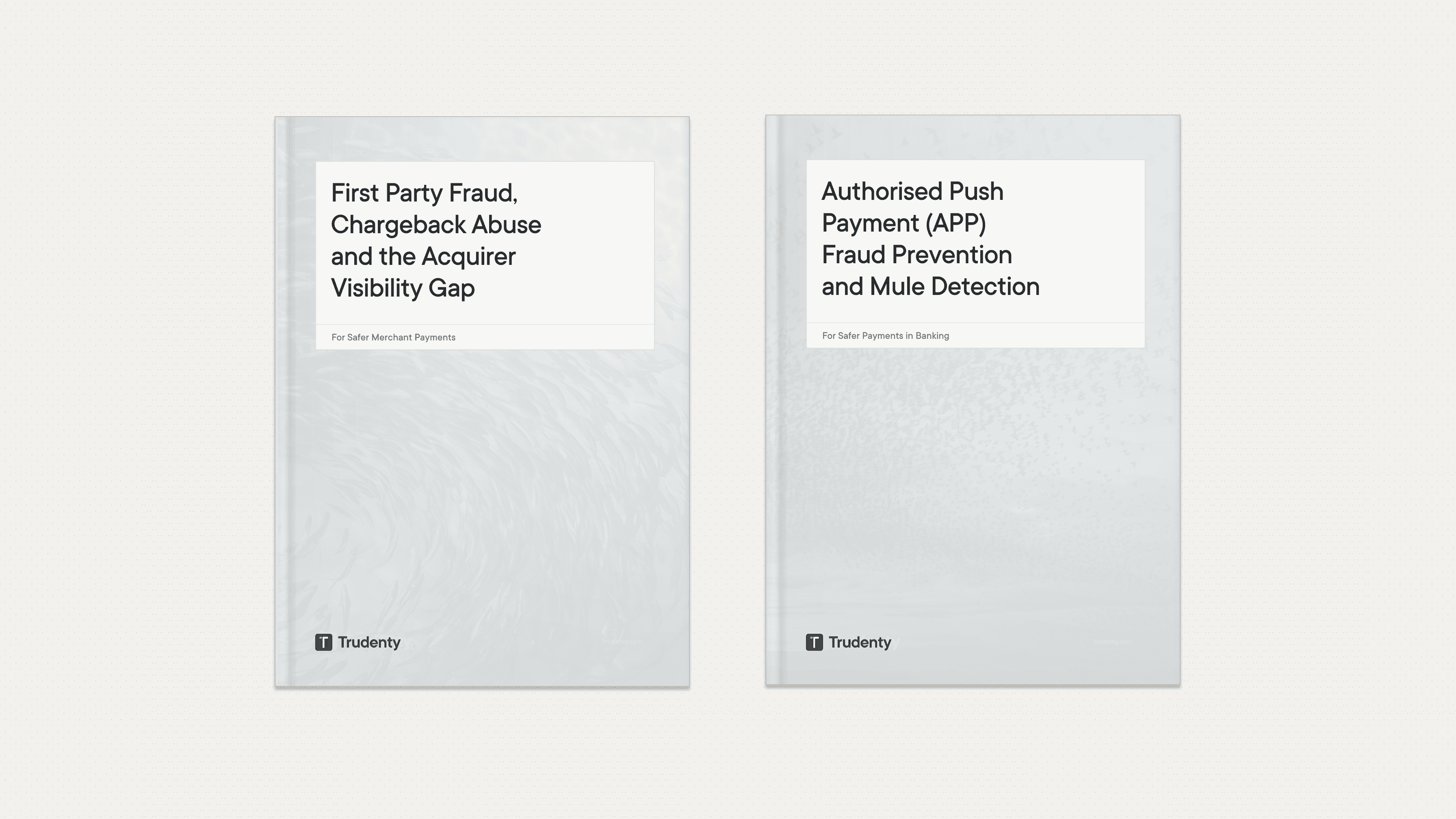
Trudenty has published two industry briefs on First-party and APP fraud covering where the gaps are, what VAMP, SMMP and the UK PSR mean in practice, and what needs to change before the loss happens rather than after.

Lerato Matsio
Fraud doesn't stay in one lane. A consumer filing repeated INR claims across a merchant portfolio and a mule account receiving APP fraud proceeds are part of the same ecosystem, but the intelligence connecting them rarely reaches the institutions that need it.
Industry estimates put first-party misuse at 75-86% of all chargebacks filed under fraud reason codes. Most of that behaviour is invisible to the acquirer processing the next transaction from the same consumer. On the banking side, real-time payments and mandatory reimbursement have moved APP fraud upstream, but scam intervention on the sending side still leaves the receiving mule account live for the next victim.
The visibility gap is structural on both sides. Closing it requires intelligence that crosses perimeters without moving raw data.
We've published two industry briefs covering where the gaps are, what VAMP, SMMP and the UK PSR mean in practice, and what needs to change before the loss happens rather than after.
Fraud doesn't stay in one lane. A consumer filing repeated INR claims across a merchant portfolio and a mule account receiving APP fraud proceeds are part of the same ecosystem, but the intelligence connecting them rarely reaches the institutions that need it.
Industry estimates put first-party misuse at 75-86% of all chargebacks filed under fraud reason codes. Most of that behaviour is invisible to the acquirer processing the next transaction from the same consumer. On the banking side, real-time payments and mandatory reimbursement have moved APP fraud upstream, but scam intervention on the sending side still leaves the receiving mule account live for the next victim.
The visibility gap is structural on both sides. Closing it requires intelligence that crosses perimeters without moving raw data.
We've published two industry briefs covering where the gaps are, what VAMP, SMMP and the UK PSR mean in practice, and what needs to change before the loss happens rather than after.
Fraud doesn't stay in one lane. A consumer filing repeated INR claims across a merchant portfolio and a mule account receiving APP fraud proceeds are part of the same ecosystem, but the intelligence connecting them rarely reaches the institutions that need it.
Industry estimates put first-party misuse at 75-86% of all chargebacks filed under fraud reason codes. Most of that behaviour is invisible to the acquirer processing the next transaction from the same consumer. On the banking side, real-time payments and mandatory reimbursement have moved APP fraud upstream, but scam intervention on the sending side still leaves the receiving mule account live for the next victim.
The visibility gap is structural on both sides. Closing it requires intelligence that crosses perimeters without moving raw data.
We've published two industry briefs covering where the gaps are, what VAMP, SMMP and the UK PSR mean in practice, and what needs to change before the loss happens rather than after.
© Trudenty Ltd 2026. All Rights Reserved.
© Trudenty Ltd 2026. All Rights Reserved.